
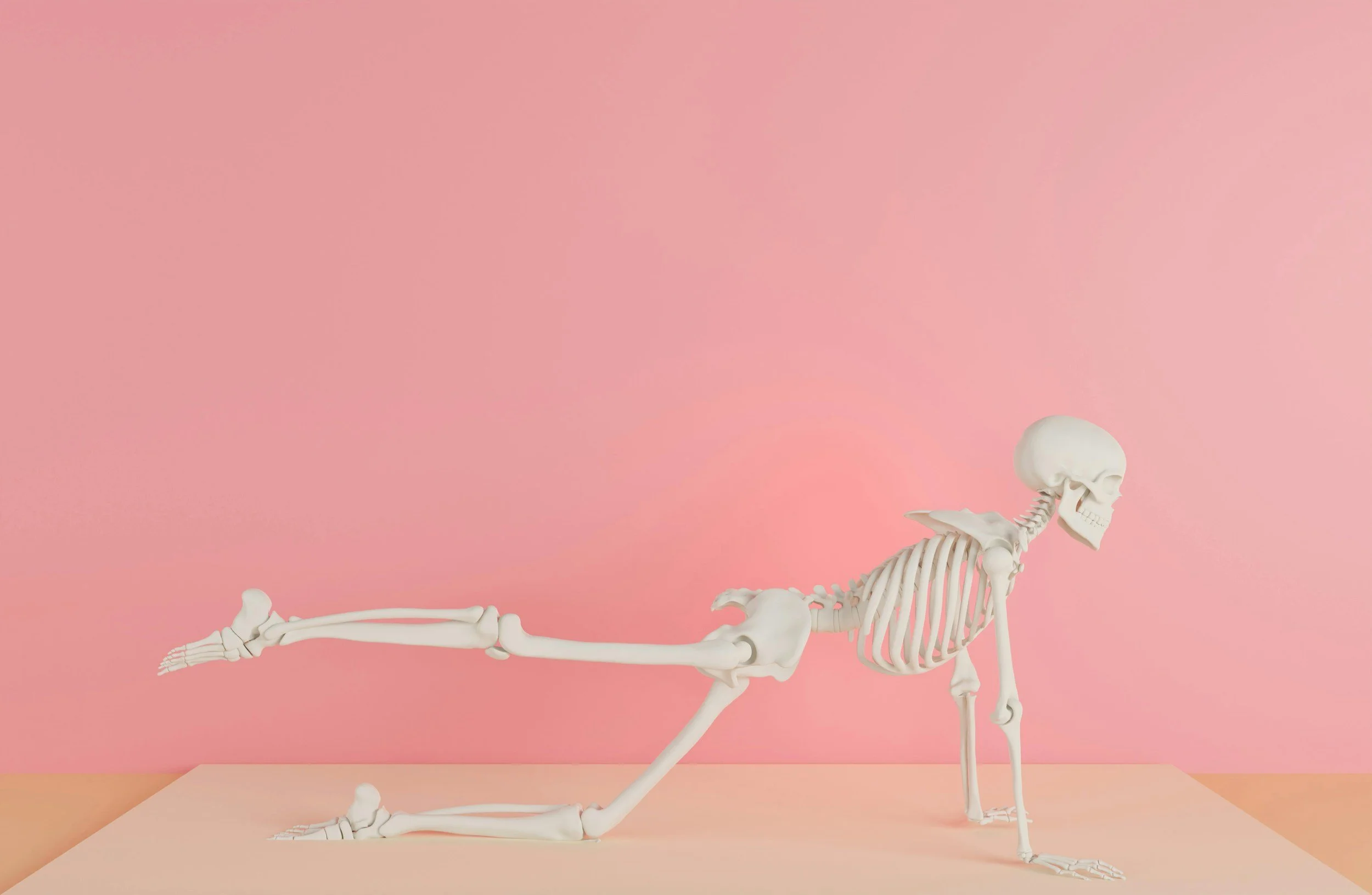
I had a DEXA scan recently and it got me thinking that in menopause, the conversation often centres on hot flushes, sleep disruption, and mood changes. But one of the most significant and frequently overlooked things happening beneath the surface is what's going on with your bones. It’s often much later in life that our carcass can start to cause issues, so my view is that it’s never to early to start taking care of the ole skeleton!
Why does bone loss accelerate at menopause?
To understand what happens at menopause, it helps to know a little about how bone works in the first place.
Your skeleton is not the static structure it might seem. Bone is living tissue, constantly being broken down by cells called osteoclasts and rebuilt by cells called osteoblasts and in younger years, this process tends to favour building. As we age, the balance tips gradually towards loss but at menopause, that tipping accelerates dramatically.
The reason is oestrogen; this hormone plays a crucial protective role in bone metabolism, essentially acting as a brake on bone breakdown. During perimenopause we know that oestrogen levels begin to fluctuate and decline and once you reach menopause oestrogen drops significantly and stays low.
Without oestrogen's protective effect, osteoclast activity increases and bone is resorbed faster than it can be replaced. Research suggests that women can lose up to 10% of their bone density in the first five years after menopause. This is why postmenopausal women are disproportionately affected by osteoporosis, a condition where bones become porous, fragile, and more vulnerable to fractures.
The perimenopause years are actually a window of opportunity, because the earlier you start supporting your bones, the better equipped you'll be.
The key nutrients your bones need – and it’s not all about calcium….and calcium isn’t just about dairy products!
Calcium is the mineral most people associate with bone health and rightly so. Around 99% of your body's calcium is stored in your bones and teeth. But what's less well known is how calcium is regulated in the body.
When dietary calcium is too low, your body draws calcium from bone to maintain adequate levels in the bloodstream. This is why consistent, adequate intake matters a lot especially when oestrogen is no longer there to help regulate the process.
Good food sources: dairy products (milk, yoghurt, cheese), but also fortified plant milks, sardines and salmon with bones, tofu (if made with calcium sulphate), almonds, and leafy greens like kale, pak choi, and spring greens.
Vitamin D
Vitamin D is essential for calcium absorption in the gut. Without it, even a calcium-rich diet can't do its job properly. Vitamin D also plays a direct role in bone mineralisation and helps regulate the activity of osteoblasts and osteoclasts.
In the UK, sun exposure is insufficient for most of the year to produce adequate vitamin D, and food sources alone rarely meet requirements. The NHS recommends that everyone in the UK consider a daily supplement of 10 micrograms (400 IU) of vitamin D throughout autumn and winter but many nutritional therapists suggest this may not be enough for optimal bone health, particularly in older adults.
Good food sources: oily fish (salmon, mackerel, sardines), eggs, fortified foods. But supplementation is typically needed during the darker months
Vitamin K2
This is one of the unsung heroes of bone health and often missing from the conversation. While vitamin K1 is involved in blood clotting, it's vitamin K2 that plays the key role in bone metabolism.
Vitamin K2 activates a protein called osteocalcin, which helps bind calcium into bone matrix. Without adequate K2, calcium may circulate in the blood and potentially deposit in soft tissues (like arteries) rather than where it's needed in your bones. When I recommend a Vitamin D supplement to midlife women I always suggest a Vitamin D/K2 combo for this reason.
Good food sources: natto (fermented soya beans …an acquired taste for some of us!), hard and soft cheeses, egg yolks, butter, and chicken. Fermented foods like sauerkraut contain some K2 as well.
Magnesium
Magnesium is involved in hundreds of biochemical reactions in the body, including bone formation. Roughly 60% of the body's magnesium is stored in bone. It also plays a role in activating vitamin D, so low magnesium can impair the whole cascade of bone-supporting nutrients. (You all know by now that Magnesium is my desert island supplement!).
Good food sources: dark leafy greens, pumpkin seeds, almonds, dark chocolate, legumes, wholegrains, and avocado. For supplementation I love the Viridian High Potency Mg, one capsule at bedtime.
Watch the bone burglars
Some dietary patterns and lifestyle factors can actively work against bone health:
Excess alcohol: heavy or regular drinking is linked to reduced bone density
Smoking : reduces oestrogen levels further and impairs calcium absorption
High caffeine intake : very high coffee consumption has been associated with modest increases in calcium excretion; moderate intake is generally fine
High salt : can increase urinary calcium losses
Very low calorie diets: chronic undereating is detrimental to bone density
High sugar and ultra-processed foods : promote inflammation and displace more nutrient-dense foods
Move Your Body In the Right Ways
Exercise is one of the most powerful tools for bone health. The key principle is mechanical loading: the stress placed on bones during exercise stimulates osteoblast activity and encourages bone formation.
Most effective for bone health:
Resistance training (weights, bodyweight exercises, resistance bands) ideally 2–3 times per week
Impact exercise (walking, jogging, dancing, tennis, aerobics) regular, varied impact is beneficial
Balance and stability work (yoga, Pilates, tai chi) helps prevent falls, which is equally important as we age
Swimming and cycling, while excellent for cardiovascular health, are low-impact and don't stimulate bone density to the same degree. They can absolutely be part of your routine, but try to incorporate load-bearing activities too.
Consider HRT
Hormone Replacement Therapy (HRT) is one of the most effective ways to protect bone density during and after menopause, as it addresses the underlying hormonal cause of accelerated bone loss. Whether HRT is appropriate for you is a personal decision made in conversation with your GP or gynaecologist, taking into account your full health picture.
Testing and bone density measurement
A DEXA scan (Dual-Energy X-ray Absorptiometry) is the gold standard for measuring bone density. It's painless, quick, and gives you a clear picture of your bone health.
You might want to discuss a referral with your GP if:
You are postmenopausal and have one or more risk factors (family history of osteoporosis, low BMI, long-term steroid use, history of disordered eating, or having had a fragility fracture)
You had an early or premature menopause . I went into early menopause at 44 and initially resisted HRT until the benefits were properly explained to me. My mum (who also had early menopause at 46) was later in life diagnosed with osteoporosis so it’s also useful to have a knowledge of your family history here.
You have a health condition associated with bone loss (such as coeliac disease, inflammatory bowel disease, rheumatoid arthritis, or hyperthyroidism)
You smoke or drink heavily
NB there is no routine DEXA scanning programme in the UK so this is something you will need to request from your GP. In addition to DEXA scanning, a blood test panel can give useful information including vitamin D levels, calcium, parathyroid hormone, thyroid function, and markers of bone turnover. A nutritional therapist or functional medicine practitioner can help you interpret these results and personalise your approach.
Bone health is one of those areas where the actions you take now will have a profound impact on your future wellbeing. The peri/menopause transition can sometimes feel like a lot to navigate but it's also a genuine invitation to invest in your health in ways that will serve you for decades to come; I definitely still want to dance at 80 years old!
If you'd like personalised support around nutrition and bone health, I'd love to help. Feel free to get in touch..
Jo x